
How to Tell if Loose Tobacco Is Bad? A Complete Guide
It happens to every roller or pipe smoker eventually. You are digging through a drawer or an old coat pocket and you find it: a forgotten pouch of loose tobacco. It might be a few months old, or maybe it’s been there since last winter.
The immediate question is: Can I still smoke this?
Unlike milk or bread, tobacco doesn’t have a strict “expiration date.” However, it is an organic material, meaning it can rot, mold, or lose its potency over time. Smoking spoiled tobacco isn’t just unpleasant—it can be a serious health risk if mold spores are involved.
This guide will walk you through the Sight, Smell, and Touch tests to determine if your stash is salvageable or if it belongs in the trash.
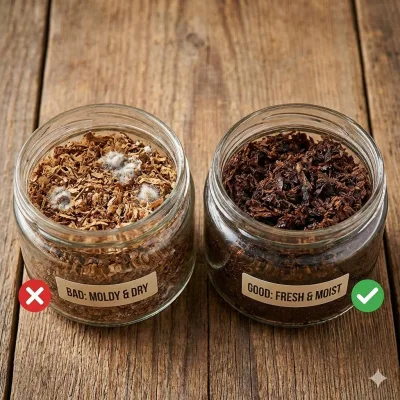 The difference is clear: Fresh tobacco (right) should look rich and dark, while spoiled tobacco (left) often appears faded with visible white mold colonies.
1. The Shelf Life of Loose Tobacco
Before inspecting the tobacco, consider how it was stored. Tobacco is sensitive to three things: Air, Moisture, and Light.
Unopened/Factory Sealed: If the pouch or tin is still factory sealed, loose tobacco can last up to 2 years if kept in a cool, dry place.
Opened (Ziploc/Pouch): Once the seal is broken, the clock starts ticking. In a standard pouch, tobacco can dry out in as little as 2 to 4 weeks.
Opened (Mason Jar): If you transferred it to an airtight Mason jar immediately, it can last for years, often improving with age like wine.
If your tobacco has been sitting in a generic Ziploc bag for 6 months, it is likely bone dry. If it has been in a damp basement, it is likely moldy.
2. The Visual Test: Mold vs. Plume
The most critical step is checking for mold. This is where many smokers get confused by “Plume” (or Bloom).
What is Mold? (BAD)
Mold is a fungus that grows on tobacco when the humidity is too high (usually above 75% RH).
Appearance: Mold looks fuzzy, hairy, or three-dimensional. It stands up off the leaf.
Color: It can be white, blue, green, or grey.
Pattern: It often grows in patchy circles or spots.
The Wipe Test: If you rub it with your finger and it smears or leaves a stain, it is mold. Do not smoke it.
What is Plume/Bloom? (GOOD)
Plume is a sign of well-aged tobacco. It occurs when oils in the leaf rise to the surface and crystallize.
Appearance: It looks like a fine, dusty white powder or sparkle. It is not fuzzy.
Color: Always white or off-white. Never green or blue.
The Wipe Test: If you brush it with your finger and it dusts off cleanly without staining the leaf, it is plume.
Important Note for RYO Smokers: Plume is relatively rare on standard rolling tobacco (like Drum, Canadian Classics, or Bugler). It is mostly found on high-end pipe tobaccos or cigars that have aged for years. If you find white spots on a standard pouch of cigarette tobacco, assume it is mold.
3. The Smell Test: Must vs. Vinegar
Your nose is a powerful detector for spoilage. Open the bag and take a deep whiff.
The “Musty” Smell (BAD)
If the tobacco smells like a damp basement, wet socks, mildew, or dirt, it has molded. Even if you can’t see the mold yet, the spores are likely present throughout the batch.
Verdict: Throw it away. You cannot “air out” moldiness.
The “Vinegar/Ketchup” Smell (IT DEPENDS)
You might open a bag and be hit with a sharp, sour scent resembling vinegar or ketchup.
In Pipe Tobacco/High-End Blends: This is often normal. Some casings (flavorings) or the natural fermentation of Virginia tobaccos produce acetic acid, which smells like vinegar. This is often a sign of a high-quality, well-aged blend.
In Cheap/Standard Tobacco: If your standard rolling tobacco smells strongly sour or chemical-like, and it didn’t smell that way when you bought it, it may be fermenting improperly due to heat exposure. While usually not dangerous, it will taste acrid and sour when smoked.
The “Lack of Smell” (NEUTRAL)
If the tobacco smells like nothing—just faint dry grass or cardboard—it has lost its essential oils. It isn’t “bad” in a safety sense, but it will be flavorless and harsh.
4. The Touch Test: Crispy vs. Slimy
Reach in and pinch a small amount of tobacco.
Too Dry (Crispy/Dusty)
If the tobacco crunches into dust when you pinch it, it has lost its moisture.
Is it safe? Yes. You can technically smoke dry tobacco, but it will burn very hot, very fast, and taste harsh.
Can it be fixed? Yes. (See “How to Rehydrate” below).
Too Wet (Slimy/Sticky)
If the tobacco feels damp, slimy, or leaves a wet residue on your fingers, it is over-humidified.
Is it safe? Likely not. Excess moisture is the breeding ground for mold. If it feels wet and has been sitting for a while, there is a high chance mold colonies are forming deep inside the pile.
Verdict: If it’s slimy, toss it.
5. Can You Fix “Bad” Tobacco?
It depends on why it is bad.
Scenario A: It is Moldy
Solution: Trash can.
There is no way to save moldy tobacco. You cannot cut the mold off like cheese, as the spores are microscopic and pervasive. Smoking mold can cause respiratory infections or allergic reactions.
Scenario B: It is Dry/Stale
Solution: Rehydration.
If the tobacco is just dry, you can bring it back to life. However, note that while you can restore the moisture, you cannot restore the flavor oils that evaporated. It will smoke better, but it might taste milder.
How to Rehydrate Loose Tobacco Safely:
The Hydro Stone Method (Best): Soak a terracotta hydro stone in water for 5 minutes, dry the surface, and drop it into the jar with the tobacco. Check in 24 hours.
The “Damp Towel” Method: Wet a clean paper towel with distilled water (don’t use tap water; it can cause mold). Squeeze it out so it is just damp, not dripping. Place it over the opening of the jar/bowl (not touching the tobacco directly) and seal it for a few hours.
The “Apple Peel” Method (Old School): Throw a slice of apple or orange peel into the bag.
Warning: Fruit rots. If you leave the peel in for more than 24 hours, you will introduce mold to your tobacco. Use this method only for short-term fixes.
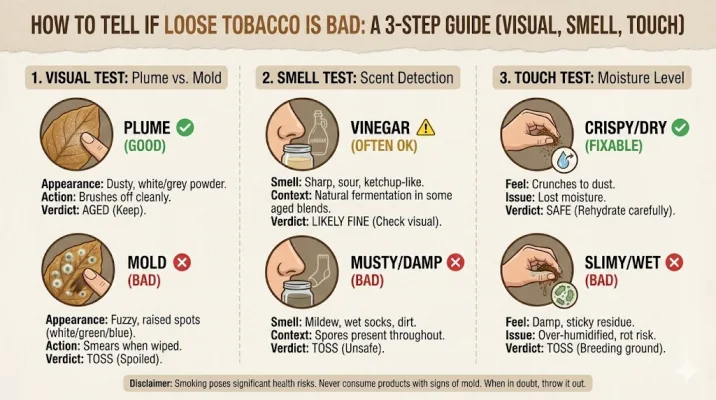 Use this 3-step checklist to inspect your stash. Remember: “Plume” dusts off cleanly, but “Mold” smears and smells musty.
6. Summary Checklist: Keep or Toss?
| Sign | Verdict |
| White Fuzzy Spots | TOSS. This is mold. |
| White Dusty Powder | KEEP. This is plume (mostly on pipe tobacco). |
| Smells Musty/Damp | TOSS. Mold spores are present. |
| Smells Like Vinegar | KEEP. Usually natural fermentation (unless it’s cheap RYO). |
| Crunchy/Dry | SAVE. Rehydrate carefully. |
| Slimy/Wet | TOSS. Rot has set in. |
| Smells Like Nothing | SMOKE. But it will be tasteless. |
7. Prevention: How to Store Tobacco Properly
To avoid wasting money in the future, follow these 2026 storage standards:
Get Mason Jars: The thin plastic pouches tobacco comes in are not designed for long-term storage. Transfer loose tobacco to glass Mason jars immediately.
Use Boveda Packs: Buy 62% or 69% relative humidity (RH) packs and drop one in the jar. This takes the guesswork out of keeping tobacco fresh.
Keep it Cool: Store your jars in a cupboard or drawer. Heat accelerates the breakdown of oils and encourages mold.
The Bottom Line:
If your tobacco is dry, give it a drink. If your tobacco is moldy or smells like a basement, cut your losses. Your lungs are worth more than a $20 bag of tobacco.
